AI Humanizer Tools: Do They Actually Work in 2026?
AI humanizer tools can make AI-assisted writing sound more natural, but detection-evasion promises are unreliable. Here is where they help and where the risks begin.

"AI humanizer" tools promise to take text written by ChatGPT or other AI models and rewrite it so it reads as human-written — and passes AI detection tools in the process. They're some of the most-searched AI tools right now, but the honest answer to whether they work is more complicated than most product pages admit.
What AI Humanizers Actually Do
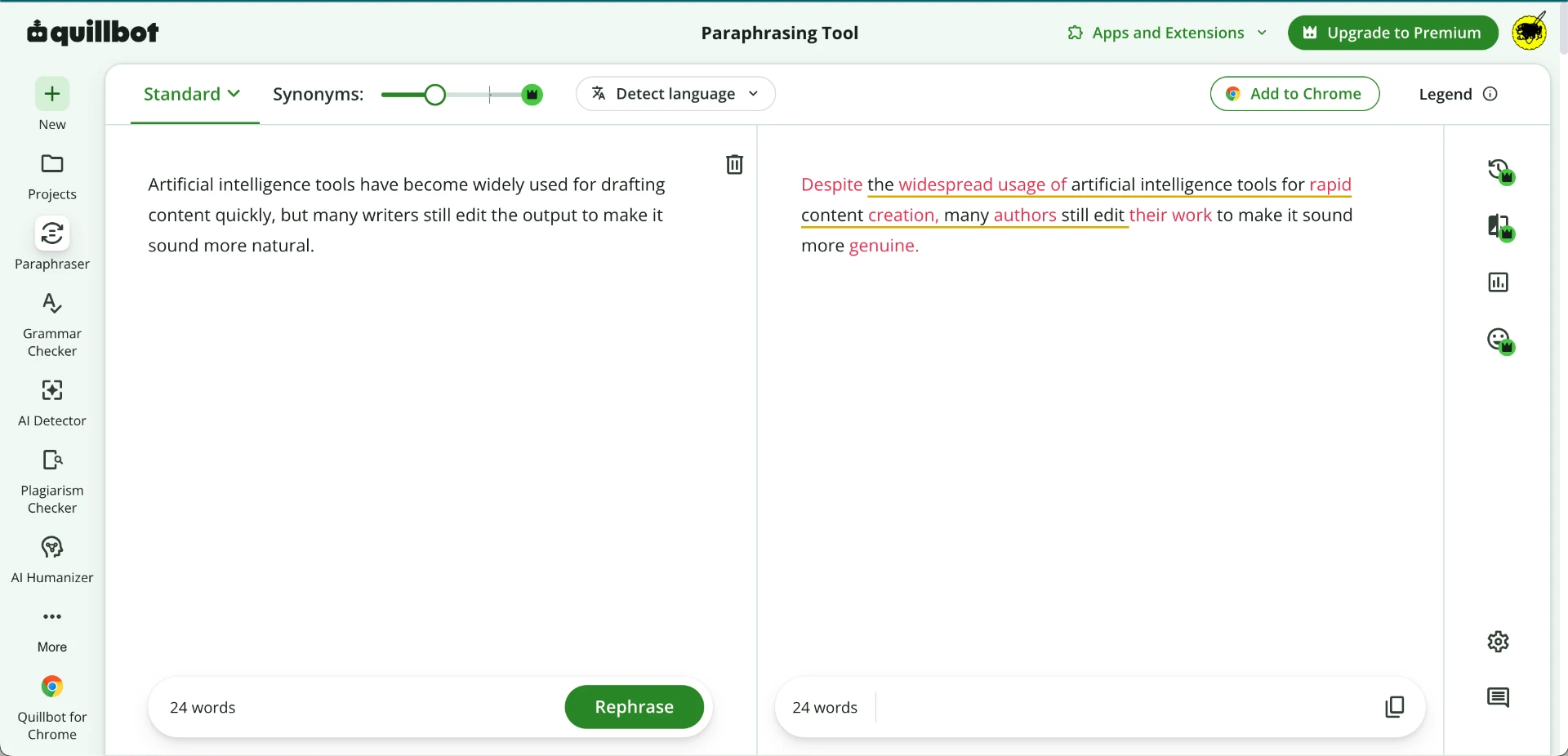
These tools take AI-generated text and rewrite it using techniques that make the writing statistically less "AI-like" — varying sentence length, swapping predictable word choices for less common ones, and breaking up the overly even rhythm that detectors flag. Some are standalone products built specifically for this purpose; others are a feature bolted onto paraphrasing tools like QuillBot.
Functionally, a humanizer is a specialized paraphraser. It's not adding original thought — it's restructuring existing AI output to look different on a statistical level.
See it in action
Do They Actually Beat AI Detectors?
Sometimes, and inconsistently. Because AI detectors work by scoring text against patterns like predictability and sentence-length variation (covered in our AI detection guide), a humanizer that successfully disrupts those patterns can lower a detection score — sometimes significantly.
But results vary a lot between tools, between detectors, and even between runs of the same tool on the same text. A humanized passage that scores "likely human" on one detector can still score "likely AI" on another. None of the marketing claims of "100% undetectable" hold up consistently under independent testing, and detector companies also update their models over time specifically in response to humanizer techniques.
Where This Gets Legitimate
Not every use case here is about evading detection. Humanizing tools — and paraphrasing tools more broadly — have real, defensible uses:
- Non-native English speakers often use AI to draft ideas, then a humanizer or paraphraser to make the phrasing sound more natural and less stiff.
- Editors and marketers use them to break up repetitive AI-generated copy so it doesn't read like a template.
- Writers with accessibility needs sometimes rely on AI drafting plus humanizing as part of a legitimate writing workflow, not to deceive anyone.
In these cases, the goal is better writing, not concealment.
Where It Gets Genuinely Risky
The picture changes when a humanizer is used specifically to submit AI-generated work as your own — in a classroom, for a job application, or anywhere originality is an explicit requirement. Two real risks apply here, separate from any ethical concern:
- Detection isn't static. A tool that evades detectors today may not next month, since detection models are retrained against exactly this kind of evasion.
- Institutions increasingly combine methods. Many schools and employers now pair automated detection with process-based checks — draft history, writing-style consistency, or direct questioning — that a humanizer can't defeat, because it only changes the final text, not the absence of a real drafting process behind it.
We're not going to pretend this use case doesn't exist, but we're also not going to frame humanizers as a reliable way around academic or professional integrity rules. The risk of consequences is real, and the tools are not as reliable as their marketing suggests.
Our Take
AI humanizers are legitimate style tools when the goal is better, more natural writing — and an unreliable, increasingly risky option when the goal is concealment. If you're using one to smooth out AI-assisted drafting for your own genuine work, that's a normal part of a modern writing workflow. If you're using one to submit work that isn't meant to be your own, understand that "undetectable" is a marketing claim, not a guarantee.
For general text refinement, a tool like QuillBot — built primarily for paraphrasing and grammar, with humanizing as a secondary feature — is a reasonable starting point, alongside checking the current landscape of dedicated humanizer tools directly.
Frequently Asked Questions
Can AI detectors always catch humanized text? No — but they can't always miss it either. Results are inconsistent across tools and change as detectors update their models, so there's no reliable guarantee either way.
Is using an AI humanizer against the rules? It depends entirely on the context. Using one to improve your own writing's natural flow is generally fine; using one to disguise AI-generated work as entirely your own where originality is required can violate academic or workplace policies.
Are free AI humanizer tools as effective as paid ones? Not usually. Free tiers typically apply lighter rewriting, while paid tools tend to offer more aggressive restructuring — though "more aggressive" doesn't guarantee it beats every detector.